Durable rental income is income that can remain reasonably dependable through normal changes in tenant demand, turnover, competition, and market conditions. It is not simply the highest rent an investor can advertise today. A property with slightly lower but consistently achievable rent can produce a stronger long-term income profile than one that depends on aggressive rent assumptions or a narrow tenant pool.
That distinction matters throughout San Luis Obispo County because rental markets vary by community, property type, renter profile, and time of year. A Cal Poly-oriented rental in San Luis Obispo operates differently from a long-term family rental in Atascadero, a duplex in Grover Beach, or a workforce-oriented property in Paso Robles.
For investors, the key question is whether enough qualified tenants are likely to want the property at a rent that supports the investment without requiring unusually favorable conditions. Durable rental income comes from repeatable demand, realistic pricing, controlled vacancy, practical lease structure, and a property that remains useful as renter preferences change.
The strongest rental investment is therefore not necessarily the one with the highest projected monthly rent. It is often the property capable of producing income consistently across multiple leasing cycles.
Central Coast Neighborhood Video Tour ⬇️
Sustainable Income Starts With Achievable Rent
Rental projections should begin with what the market is actually supporting rather than the highest advertised rent an investor can find.
👉 How to Evaluate Cash Flow on an Investment Property on the Central Coast
An asking rent represents a landlord’s target. It does not establish that a tenant signed a lease at that amount. Investors should examine a range of comparable properties and consider how quickly those rentals appear to move, whether asking prices are being adjusted, and whether incentives are being offered.
A property advertised at $3,500 per month but sitting vacant for an extended period may produce less annual income than a comparable property consistently occupied at a slightly lower rent. Vacancy changes the economics quickly because the lost income generally cannot be recovered once the month has passed.
This is why rental durability begins with a conservative income assumption. An investment that performs adequately at a supportable rent has more resilience than one that depends on obtaining the highest visible number in the market.
After more than 30 years in real estate, Joesef Jackson has seen investors improve their analysis by separating possible rent from repeatable rent. The second number usually matters more when evaluating long-term performance.
Vacancy Can Change an Attractive Rent Into Weak Annual Income
Monthly rent receives considerable attention because it is easy to compare. Annual occupancy deserves equal attention.
👉 How Vacancy Rates and Rental Demand Affect Investment Decisions in San Luis Obispo County
A property generating a premium monthly rent but experiencing recurring vacancy can underperform a lower-rent property with consistent occupancy. Investors should therefore evaluate the relationship between rent level and the depth of the tenant pool.
The U.S. Census Bureau publishes housing vacancy information that provides broader context for rental supply and occupancy trends.
Local analysis should go further. Investors need to study the vacancy experience of comparable units, not simply a national, statewide, or countywide average.
A two-bedroom apartment near downtown San Luis Obispo may have a different leasing pattern from a four-bedroom home in Paso Robles. A coastal rental in Morro Bay may serve a different tenant group from a conventional residence in Arroyo Grande.
Durable income depends on how frequently the specific property is likely to remain occupied at its intended rent.
Properties With Broad Use Cases Can Preserve Demand
A good long-term rental typically works for more than one narrowly defined tenant.
👉 What Makes a Good Long-Term Rental Property in San Luis Obispo County?
Consider a two-bedroom residence with practical parking, in-unit laundry, useful storage, and reasonable access to employment. It may appeal to a couple, roommates, a small family, relocating professionals, or someone working remotely.
A highly specialized unit may have fewer alternatives. An unusual layout, limited parking, very small secondary bedrooms, or a property designed primarily around one temporary demand source can reduce the number of renters who consider it suitable.
This does not mean specialized rentals should be avoided. Properties near Cal Poly, for example, can serve a clearly identifiable renter population. The investor should simply understand how dependent the income is on that particular demand source.
With more than 2,130 career transactions, Joesef has observed that rental properties tend to remain easier to reposition when their basic usefulness extends beyond one exact renter profile.
Yield Matters, but It Does Not Measure Income Durability by Itself
Investors often use cap rate and other return metrics to compare properties. Those numbers are valuable, but they are only as reliable as the assumptions underneath them.
👉 What Cap Rate Means for Central Coast Investment Properties
A favorable projected return can deteriorate when the assumed rent is difficult to achieve or vacancy is underestimated. Conversely, a property with a less dramatic initial return may produce more consistent results when the income assumptions are conservative and the tenant pool is deep.
Investors should examine why a property appears to produce a higher return than competing opportunities. Sometimes the answer is genuine value. In other cases, the calculation may rely on optimistic rent, unusually low expense assumptions, or temporary conditions.
The strongest analysis tests the investment under more than one scenario. If the property still performs reasonably when rent growth slows or vacancy increases modestly, the income profile is less dependent on perfect execution.
Durability means the investment does not require every assumption to move in the owner’s favor.
Flexibility Can Be Worth More Than Maximum Initial Rent
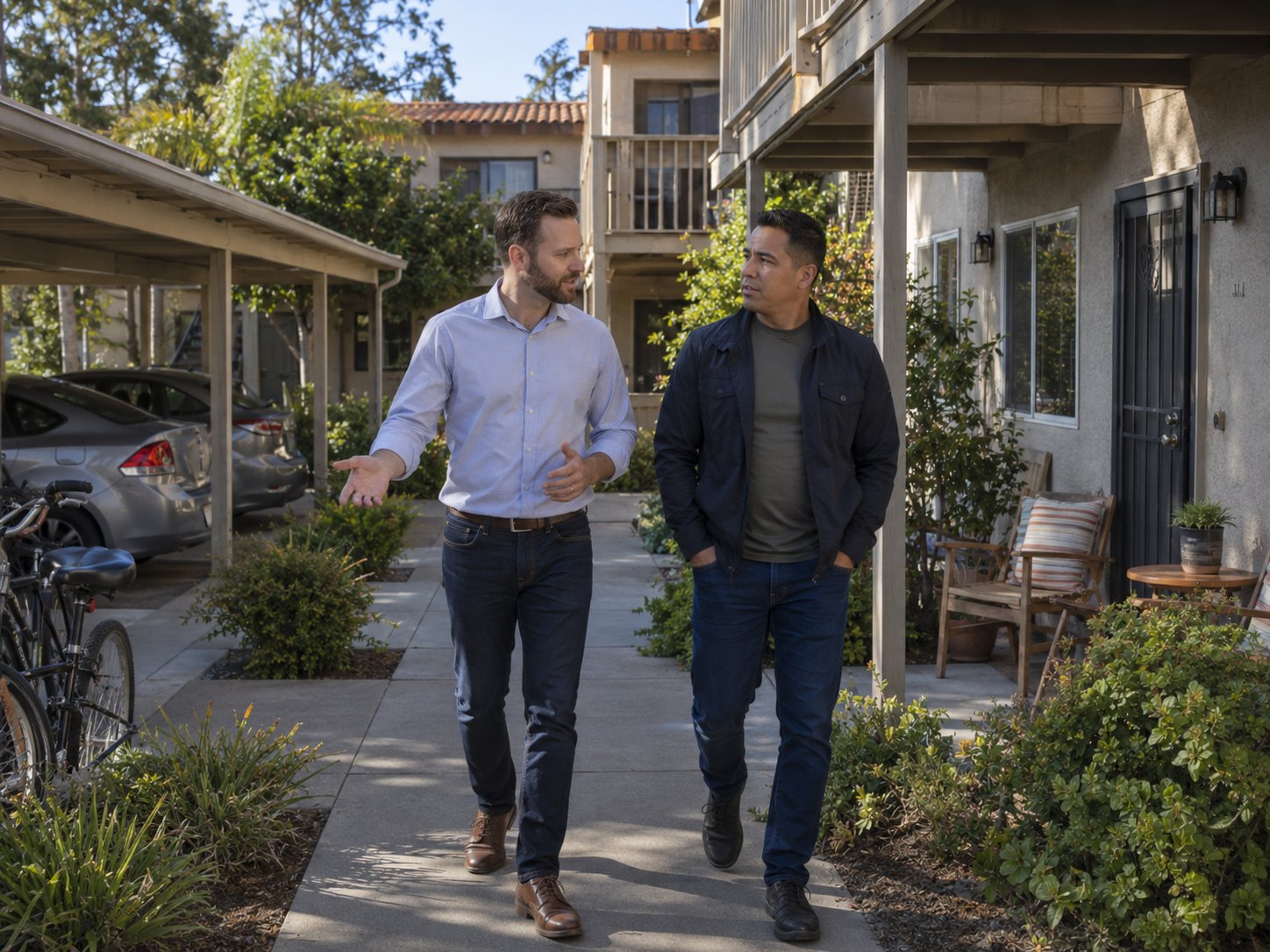
Rental properties often change along with the households that occupy them.
👉 How Investors Should Compare Cash Flow and Flexibility in San Luis Obispo County
A unit with an adaptable layout may be able to serve different renter groups without significant changes. A den may function as a work area, a usable garage may appeal to tenants with equipment or recreational gear, and a fenced outdoor area may expand the renter pool for certain households.
The investor should distinguish between features that merely justify a higher advertised rent and features that make the property relevant to more tenants.
Flexibility can also affect future strategy. A property may initially operate as a long-term rental while retaining appeal to an owner-occupant later. A duplex may provide different occupancy options from a single-family residence. A property with legally recognized additional living space may create possibilities that a more rigid configuration does not provide.
The value of flexibility is that it gives the owner more than one path when market conditions change.
Rent Stability Can Be More Valuable Than Rapid Rent Growth
Investors sometimes view rising rents as the strongest sign of an attractive market. Rapid increases can be favorable, but stability deserves attention as well.
👉 How Investors Should Evaluate Local Rent Stability on the Central Coast
A rental market in which tenants consistently accept moderate rents can provide a more predictable foundation than one experiencing sharp increases followed by resistance.
Investors should watch what happens when landlords test higher prices. Do comparable units continue leasing efficiently? Do they remain available longer? Are owners beginning to advertise concessions or reduce asking rents?
The answers reveal whether renter incomes and preferences continue to support the prevailing rent level.
Rent stability is particularly important for investors using financing. Debt obligations generally remain due regardless of whether an ambitious rental projection is achieved. A property with income that remains supportable across different leasing environments can therefore provide a stronger operating base.
The objective is not to avoid rent growth. It is to distinguish sustainable growth from rent levels that require increasingly favorable market conditions.
Tenant Retention Protects More Than Occupancy
A tenant who remains for an additional lease period can reduce several sources of income interruption.
Turnover can involve vacancy between tenants, advertising, screening, lease preparation, cleaning, and time spent coordinating the transition. Those costs may be manageable individually, but frequent turnover can meaningfully affect annual performance.
Tenant retention does not mean an investor should accept every lease renewal regardless of circumstances. It means the property should provide enough value that qualified tenants have a reason to remain when the lease continues to make sense for both parties.
A rental that fits daily life well may have advantages over one selected mainly because it was the only available choice at move-in. Practical access, appropriate space, parking, privacy, and a reasonable relationship between rent and property quality can influence whether tenants continue occupancy.
An investor seeking durable income should therefore study tenant behavior after move-in, not only the level of interest before the lease is signed.
Lease Timing Can Influence Revenue Across the Year
The month in which a lease expires can affect how easily the property returns to the market.
Rental activity is not identical throughout the year. Student-oriented properties in San Luis Obispo may experience leasing patterns influenced by the academic calendar. Other rentals may see stronger demand during periods when households traditionally relocate.
Investors should understand when the likely tenant pool tends to search and consider how the lease term aligns with those patterns.
This does not mean every lease must end during the same season. It means lease timing can become an operational decision rather than an accidental result of the original move-in date.
A property consistently returning to market during a period of weak demand may experience longer vacancy or greater price sensitivity. Adjusting lease duration when appropriate can eventually reposition the property into a more active leasing window.
Small operational decisions like these can affect the consistency of annual income without changing the physical property.
Rent Levels Need to Match the Depth of the Tenant Pool
Every increase in monthly rent can narrow the number of households capable of leasing the property.
A premium home may justify a premium rent, but investors should evaluate how many qualified tenants exist at that level.
This is particularly relevant with larger single-family rentals and highly improved properties. A residence may theoretically support a high asking rent based on its size and finish level while competing for a relatively limited number of households able and willing to pay it.
The investor should ask whether the additional rent compensates for the possibility of a smaller renter pool.
A property positioned within a broad affordability band may have more leasing options when demand softens. The owner can still compete through condition, features, or lease terms without immediately depending on a large reduction.
Durable income often comes from finding the intersection between rent potential and renter depth rather than maximizing one while ignoring the other.
New Rental Supply Can Test Previously Strong Income
Rental durability depends partly on what tenants can choose instead.
When new apartments, townhomes, accessory units, or other rental options enter a market, existing properties may face additional competition even if the overall renter population remains healthy.
Newer rental communities may compete through modern finishes, amenities, energy efficiency, professional management, or move-in incentives. Older properties may retain advantages through location, larger rooms, yards, parking, privacy, or lower rents.
Investors should therefore watch both renter demand and rental supply.
A market can have strong underlying demand while one particular unit type becomes more competitive because a large amount of similar inventory has been added.
The investor should ask whether the property has a durable reason to be chosen when renters have alternatives. Price can be one reason, but it should not be the only one.
Income Durability Depends on More Than a Single Employer or Institution
Local employment, education, healthcare, tourism, agriculture, and professional services can all contribute to rental demand in different parts of San Luis Obispo County.
A property whose tenant pool comes from several sources may be less dependent on one specific demand driver.
This does not diminish the value of a strong institutional anchor. Cal Poly, for example, creates a substantial housing influence in San Luis Obispo. The investor should simply understand whether the property's economics depend almost entirely on one renter category or can also appeal to other households.
Paso Robles can attract tenants connected to hospitality, wine, healthcare, professional services, and other employment. South County rentals may draw households working across Arroyo Grande, Grover Beach, Pismo Beach, and surrounding areas.
The stronger the number of realistic reasons a tenant may want to live near the property, the less dependent income becomes on one narrow source of demand.
Regulation and Lease Structure Belong in the Income Analysis
Gross rent is not the same as unrestricted income.
Investors should understand the legal framework applicable to the property, including lease terms, deposits, notices, rent-related rules, and local requirements that may affect operation.
The California Department of Real Estate publishes landlord and tenant guidance covering responsibilities within California rental housing.
Investors should obtain appropriate legal or property-management guidance for requirements affecting a specific property rather than assuming that operating practices used elsewhere automatically apply.
Lease structure also influences predictability. The duration of the lease, responsibility for certain services, renewal timing, and other lawful terms can affect how stable the income stream becomes.
A good investment model should be based on the property as it can actually be operated, not on a theoretical version unconstrained by applicable rules or lease obligations.
Tenant Quality and Rent Level Should Be Evaluated Together
Durable income depends on receiving rent consistently, not merely signing a lease at the highest possible number.
Investors should apply lawful, consistent screening standards and evaluate applicants according to appropriate criteria. A property attracting sufficient qualified applicants gives the owner more flexibility than one where the rent must be repeatedly stretched to justify the acquisition.
This is another reason tenant depth matters. A larger pool of qualified prospective renters can reduce dependence on any one applicant or leasing event.
The investor should resist the temptation to view the maximum possible rent as the only measure of performance. A slightly more conservative rent that attracts a deeper qualified pool may produce stronger annual results if it supports faster leasing and longer tenancy.
Income durability is built through repeatability.
Conservative Underwriting Creates More Room for Real-World Variation
No rental projection will unfold exactly as modeled.
Tenants move. Leasing conditions change. Rent growth slows. New competition appears. A unit can be vacant longer than expected.
Investors can account for this uncertainty by underwriting a range of outcomes rather than building the acquisition around an ideal case.
A durable rental property should not require continuous rent increases to remain viable. Nor should its financial performance collapse because one leasing period takes longer than expected.
Joesef Jackson’s experience representing investment real estate on the Central Coast has shown that the most useful investment conversations often focus on what happens when assumptions are slightly wrong. If the property still makes sense under reasonable variations, the investment has more operating room.
That is a different standard from simply showing that the numbers work on opening day.
Durable Rental Income Comes From Repeatable Performance
The strongest rental income is rarely created by one exceptional lease.
It comes from a property continuing to attract qualified tenants, achieving supportable rents, limiting unnecessary vacancy, and remaining relevant as competing inventory and renter preferences evolve.
An investor may own a property through several leasing cycles and several different market environments. The question is whether the underlying rental proposition remains sound each time the unit becomes available.
For a San Luis Obispo apartment, that may come from proximity and persistent housing demand. For an Arroyo Grande or Grover Beach rental, it may come from useful housing at a rent accessible to the local workforce. In Atascadero or Paso Robles, it may come from space, parking, and residential utility that appeals to longer-term households.
Durability is ultimately about repeatability. When demand, rent, property type, and tenant profile remain aligned, the income does not need extraordinary market conditions to continue performing.
Frequently Asked Questions
What does durable rental income mean?
Durable rental income is rent that has a reasonable likelihood of remaining supportable through changing tenant demand, turnover, competition, and normal market cycles.
Is the highest possible rent always best for an investment property?
No. A higher rent may reduce the qualified tenant pool or increase vacancy. Investors should compare maximum rent with achievable annual occupancy and effective income.
How does vacancy affect rental income?
Vacancy eliminates income for the period the unit is unoccupied and can also create leasing and turnover expenses. Even short vacancies can materially affect annual results.
Why does tenant retention matter to investors?
Longer tenancy can reduce vacancy periods and the frequency of leasing-related expenses while creating a more continuous income stream.
Can new apartment construction affect existing rental properties?
Yes. New supply can give tenants additional alternatives and may increase competition, particularly when the new units target the same renter group and price range.
Is rent stability more important than rent growth?
Both matter, but stable, supportable rent can be more valuable than temporary increases that lead to longer vacancy, concessions, or tenant resistance.
What property types tend to have durable tenant appeal?
There is no single property type. Rentals with practical layouts, useful locations, appropriate rent levels, and features relevant to a sufficiently broad renter pool may have stronger repeatable demand.
How should investors forecast future rental income?
Investors should use multiple comparable rentals, realistic vacancy assumptions, supportable rent ranges, competing supply, turnover patterns, and conservative scenarios rather than relying on one optimistic projection.
If you are preparing to buy or sell real estate on the Central Coast and want personalized guidance, contact Joesef Jackson at SLO Life Realty Group.