Cap rate is one of the most important metrics real estate investors use to evaluate investment properties on the Central Coast. In San Luis Obispo County, where property values and rental demand vary by location, understanding cap rate helps investors compare opportunities and assess potential returns more effectively.
In many Central Coast transactions, what often stands out is that investors who understand cap rate early make more disciplined and data-driven decisions rather than relying on surface-level pricing alone.
What Cap Rate Actually Means
Cap rate, or capitalization rate, measures the expected return on an investment property based on its income relative to its purchase price. It is calculated by dividing net operating income (NOI) by the property value.
👉 How Property Taxes Work for Investment Properties in San Luis Obispo County
A higher cap rate typically indicates higher potential return, but often comes with increased risk. Lower cap rates may reflect more stable or desirable areas.
Why Cap Rate Matters on the Central Coast
On the Central Coast, cap rate is especially important because property values tend to be higher while rental yields can vary. This creates a different investment dynamic compared to lower-cost markets.
👉 Is Buying a Rental Property on the Central Coast Still a Smart Investment?
Investors must balance appreciation potential with income performance to determine whether a property fits their goals.
How to Calculate Cap Rate
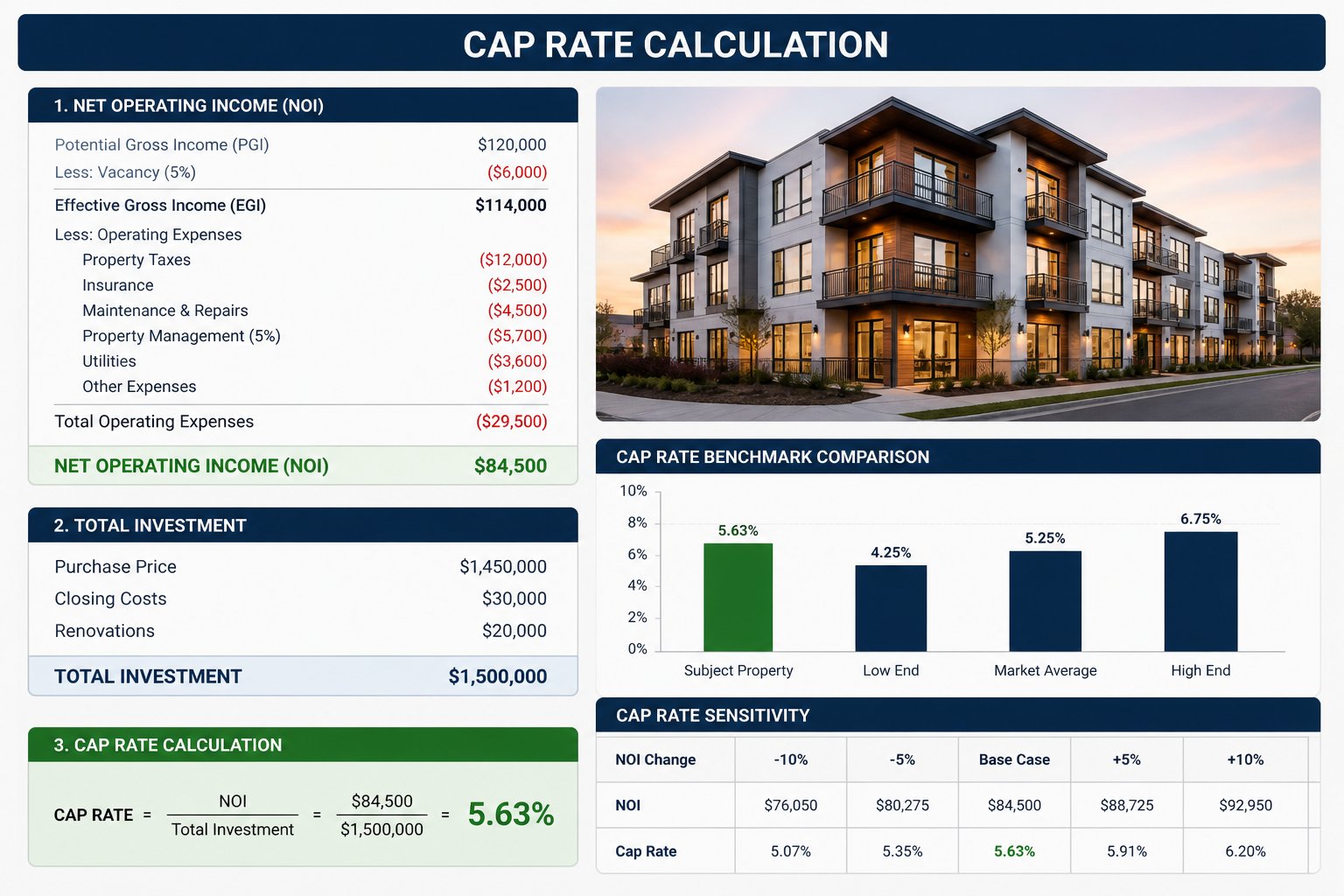
To calculate cap rate, investors subtract operating expenses from rental income to determine net operating income. That number is then divided by the purchase price.
👉 How Bridge Loans Work When Buying and Selling a Home in San Luis Obispo County
This calculation provides a quick way to compare different investment opportunities.
What Is a Good Cap Rate in San Luis Obispo County?
There is no single “good” cap rate—it depends on the property type, location, and investment strategy. On the Central Coast, cap rates are often lower due to strong demand and limited inventory.
👉 What Makes a Property Easy to Rent in San Luis Obispo County
Lower cap rates in desirable areas may still be attractive due to long-term appreciation and stability.
Cap Rate vs Appreciation Strategy
Cap rate focuses on income, while appreciation focuses on value growth over time. Many Central Coast investors prioritize appreciation due to the region’s strong long-term demand.
👉 How to Identify Undervalued Properties in San Luis Obispo County
👉 What Today’s Central Coast Real Estate Market Means for Your Long-Term Plans
Balancing these two approaches is key to building a successful investment strategy.
Limitations of Cap Rate

Cap rate is useful, but it does not account for financing, taxes, or future market changes. It is one piece of a larger investment analysis.
The California Association of REALTORS® provides market data that helps investors evaluate pricing trends and rental demand across different regions.
Investors should use cap rate alongside other metrics to make well-rounded decisions.
How Market Conditions Affect Cap Rates
Market conditions directly impact cap rates. As property values rise faster than rents, cap rates tend to compress. When values stabilize or rents increase, cap rates may improve.
The California Department of Real Estate provides guidance on evaluating market conditions and investment considerations.
Understanding these dynamics helps investors interpret cap rate correctly rather than relying on it in isolation.
Using Cap Rate to Compare Opportunities
Cap rate allows investors to compare properties across different locations and price points. It provides a standardized way to evaluate performance potential.
By using cap rate alongside location analysis and long-term planning, investors can make more informed decisions about where to allocate capital.
FAQ
What is a cap rate in real estate?
It is a measure of return based on a property’s income relative to its value.
What is considered a good cap rate?
It varies by market, but lower cap rates are common in high-demand areas like the Central Coast.
Should I rely only on cap rate?
No, it should be used alongside other metrics and market analysis.
If you’re evaluating investment opportunities and want to better understand cap rates on the Central Coast, contact me.
Internal Linking Note
Some plain-text references in this article will become live internal links as additional Central Coast real estate guides are published.