
Vacancy risk is the possibility that a rental property will produce less income because a unit is unoccupied, takes longer than expected to lease, or must be repositioned before another tenant will accept it. For investors in San Luis Obispo County, the important question is not whether a vacancy will ever occur. Over a long ownership period, some turnover is normal. The more useful question is how often vacancies are likely to occur, how long they may last, and how much financial pressure they could create.
That requires looking beyond a single vacancy-rate statistic. A property’s exposure is influenced by its tenant pool, rent range, unit type, lease timing, competition, turnover pattern, and how quickly the unit can return to the rental market.
The mathematics also change by property type. One vacant single-family rental temporarily loses all of its rental income. One vacant unit in a four-unit property may reduce revenue substantially without eliminating it altogether. An investor with several properties faces yet another calculation because vacancies can occur across the portfolio at different times.
Vacancy risk should therefore be treated as a specific financial exposure attached to each investment—not simply a generic percentage inserted into a spreadsheet.
Central Coast Neighborhood Video Tour ⬇️
Vacancy Risk Is a Combination of Probability, Duration, and Financial Exposure
Investors can evaluate vacancy more effectively by separating it into three questions: How likely is the unit to become vacant? How long could it remain vacant? What happens financially while that income is missing?
👉 How to Evaluate Risk in Real Estate Investments on the Central Coast
A unit with frequent turnover but extremely fast re-leasing may present a different risk from one where tenants remain for years but vacancies routinely take several months to fill.
Likewise, a property with modest debt may tolerate an empty month differently from a highly leveraged property carrying substantial fixed obligations.
This is why vacancy should not be represented by one arbitrary percentage without context. The same 5% annual vacancy assumption can describe very different real-world situations.
The U.S. Census Bureau describes rental vacancy rates as a measure of available rental housing relative to rental demand and uses vacancy as an indicator of housing-market supply and demand.
For an individual investor, broader vacancy statistics provide context. Property-specific risk still depends on the competitive market surrounding the actual unit.
Strong Demand Can Shorten the Period Between Tenants
Some rental properties naturally compete for a deeper pool of prospective tenants.
👉 What Makes a Property High-Demand on the Central Coast
That depth matters because vacancy risk is partly about replacement speed. If several qualified households are likely to consider a property when it becomes available, an investor has more potential paths to restoring income.
Demand should be evaluated at the property level rather than inferred from the popularity of the community alone. A desirable city does not guarantee equally strong demand for every unit type or price point.
A modest apartment near employment and daily services may appeal to a broad group of renters. A large premium-priced residence may offer more space and features while serving a considerably smaller pool.
After more than 30 years working with Central Coast real estate, Joesef Jackson has seen that scarcity is most useful to an investor when it exists for the particular housing product being offered. General demand for San Luis Obispo County housing is not the same thing as demand for one specific rental configuration.
Rentability Determines How Quickly an Empty Unit Can Reenter the Market
Vacancy risk often increases when a property contains characteristics that limit the number of renters who can realistically use it.
👉 What Makes a Property Easy to Rent in San Luis Obispo County
Parking limitations, unusual bedroom arrangements, difficult access, a narrow affordability range, or a highly specialized configuration may matter more during a vacancy than they did when the previous tenant was already occupying the property.
Investors should think about the replacement tenant before they ever have one to replace.
Who is the likely next renter? How many households fit that profile? What competing choices will those households have? Does the property solve an ordinary housing need or require a renter with very specific priorities?
The easier those questions are to answer, the easier it generally becomes to estimate vacancy exposure.
With more than 2,130 career transactions, Joesef has observed that investors can learn a great deal by asking why a renter would select a particular property when several alternatives are available. That answer often reveals more about future vacancy exposure than the current lease alone.
Economic Changes Can Affect Some Renter Groups More Than Others
Vacancy risk can change when employment, household formation, relocation patterns, or broader economic conditions shift.
👉 How Economic Trends Affect Investment Properties on the Central Coast
The impact is rarely uniform.
A rental heavily dependent on one renter profile may react differently from a property that can serve several types of households. A unit oriented toward students has different demand drivers from housing primarily occupied by local working households. Higher-priced rentals may respond differently from properties serving a broader portion of the workforce.
Investors should identify which economic circumstances are most relevant to the intended tenant rather than trying to forecast every economic variable.
A changing economy does not automatically produce high vacancy. It can instead alter which price points, locations, or property types receive the strongest renter response.
The practical risk is concentration: an investment whose success depends heavily on one narrow source of demand has fewer alternatives if that demand temporarily weakens.
Turnover Frequency Can Matter as Much as the Vacancy Rate

Vacancy and turnover are related but not identical.
👉 What Investors Should Know About Tenant Turnover on the Central Coast
A property can have relatively little annual vacancy yet require frequent tenant transitions. Another property may retain tenants for long periods but experience a longer gap when a tenant eventually leaves.
Each pattern creates a different operating challenge.
Frequent turnover creates more opportunities for cleaning, advertising, screening, lease administration, property access, and scheduling between occupancies. The lost income may be small each time but accumulate across multiple transitions.
Longer tenancy reduces the number of those events, although investors should still account for the possibility that a future turnover takes longer than anticipated.
The useful metric is not merely how many days the property was empty last year. Investors should understand what caused those vacancies and whether the same pattern is likely to repeat.
Stable Rentals Reduce Dependence on Perfect Leasing Conditions
A stable rental is not one that never becomes vacant. It is one whose demand and operating characteristics provide more than one way to recover when a vacancy occurs.
👉 What Makes a Rental Property More Stable in San Luis Obispo County
A property may benefit from a broad renter pool, established residential use, a rent range supported by multiple households, and a configuration that remains useful even when preferences shift.
Stability becomes especially valuable when competing inventory increases.
If a property can appeal to several types of tenants, the owner may have more flexibility than an investor whose property must attract one highly specific renter at one exact rent.
For example, a conventional two-bedroom unit may accommodate a couple, roommates, a small household, or relocating professionals. A highly specialized property may have fewer potential matches.
The investment does not need universal appeal. It needs enough repeatable appeal that each vacancy does not become a completely new search for an unusually specific tenant.
Lease Expiration Dates Can Concentrate Risk
Vacancy risk is partly determined months before a property becomes empty.
The expiration date written into the lease can influence when the owner next enters the rental market. That matters in areas where renter activity changes meaningfully during the year.
An investor operating several units should pay particular attention to expiration concentration. If multiple leases end within the same short period, the owner could face several vacancies simultaneously.
Spreading expiration dates may reduce the chance that a large portion of portfolio income is exposed at once, when consistent with the rental strategy and applicable requirements.
The issue can be particularly relevant with properties serving academic-cycle renters in San Luis Obispo. Other rental segments may have less pronounced seasonality but still experience periods when household movement is more active.
Vacancy planning therefore begins with lease structure, not on the day a tenant gives notice.
Single-Unit and Multi-Unit Properties Carry Vacancy Differently
Vacancy exposure should be measured against the number of income-producing units.
If a single-family rental becomes vacant, rental income from that property can temporarily fall to zero. In a duplex, one empty unit can eliminate roughly half of the property's gross rental stream until it is leased again. In a larger multifamily property, the percentage impact of one vacancy may be smaller.
That does not automatically make larger properties safer investments. They introduce different acquisition, management, and operational considerations.
It does mean investors should calculate vacancy in dollars as well as percentages.
For example, “one month vacant” is not a complete description of risk. The investor should know the income lost during that month, which fixed obligations continue, and how much portfolio cash remains available during the interruption.
This becomes especially important for investors comparing a single-family rental in Los Osos with a small multifamily property in Oceano or another San Luis Obispo County community. The income structures respond differently when one tenancy ends.
Turnover Work Can Extend Vacancy Beyond the Tenant's Move-Out Date
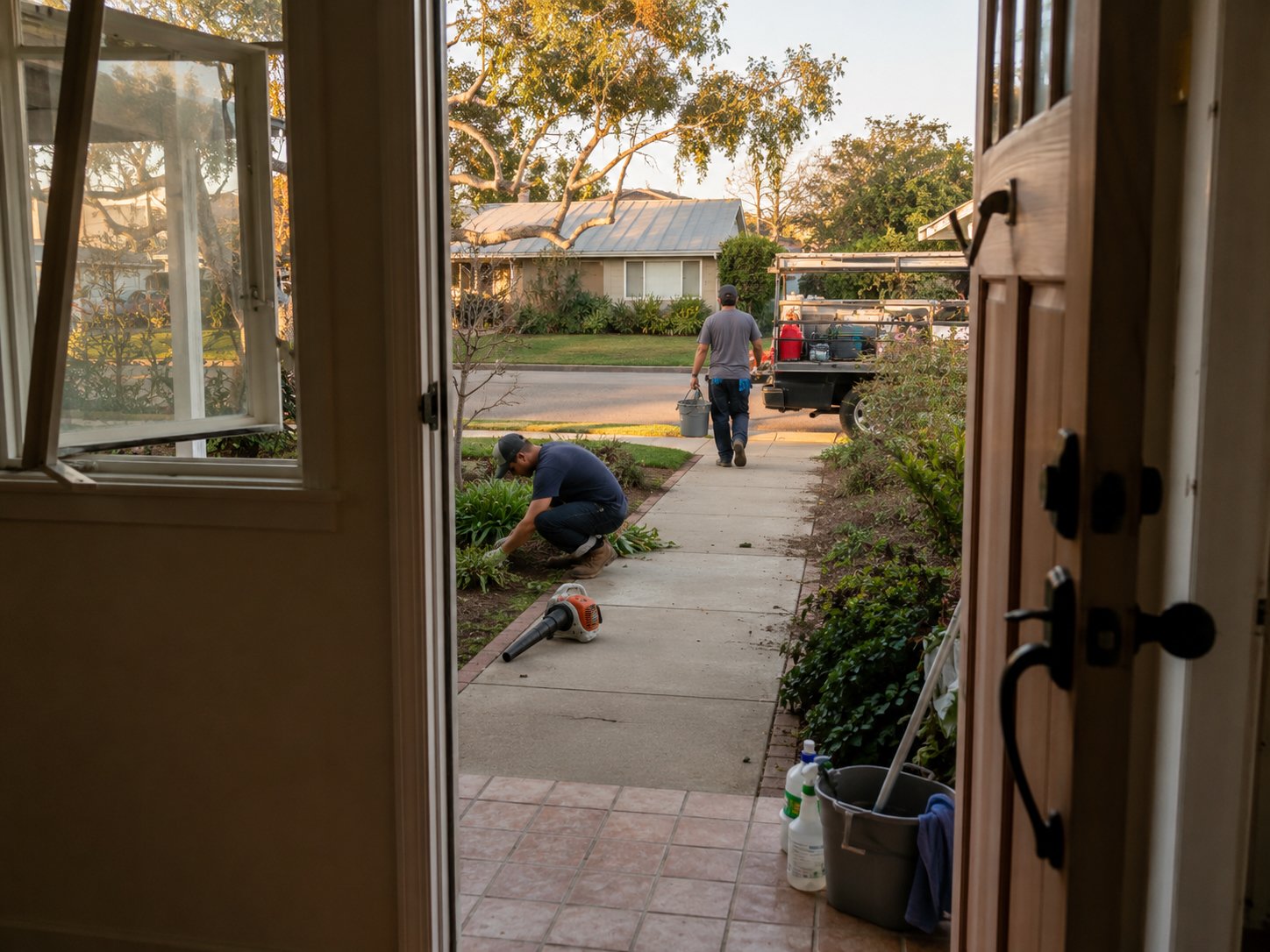
A unit does not automatically become rentable the moment the previous tenant leaves.
Cleaning, lawful repairs, painting where needed, vendor scheduling, access coordination, and other turnover work can create additional days without income.
This creates a second form of vacancy exposure: operational delay.
An investor may have strong tenant demand but still lose substantial time because the property is not ready when renters are searching. This is particularly important when vendors are busy or multiple tasks must occur in sequence.
A better vacancy estimate includes both marketing time and preparation time.
Experienced investors often plan turnover before possession is returned when circumstances allow. Vendor availability, expected work, marketing preparation, and leasing logistics can then be coordinated rather than addressed one at a time after the unit is empty.
The opportunity is not to eliminate every vacant day. It is to prevent avoidable days from being added to the transition.
Pricing Mistakes Can Create Vacancy Even When Demand Is Healthy
An empty property does not always indicate weak tenant demand.
Sometimes the problem is the relationship between the property and its asking rent.
A rental can exist within a healthy market and still sit vacant if renters perceive better value among competing options. Investors should therefore separate market vacancy from property-specific price resistance.
The distinction is important because the responses are different.
If competing rentals are also sitting vacant, the market itself may be softening. If similar units are leasing while one property remains available, the investor should examine that property's price, presentation, lease terms, timing, or configuration.
Holding too firmly to an unsupported rent can become expensive. The additional monthly amount an owner hopes to obtain should be compared with the income being lost each day the property remains empty.
Vacancy risk is therefore partly a pricing discipline problem. Investors need to know when preserving an asking rent is economically useful and when the resulting downtime costs more than the premium being pursued.
New Rental Supply Can Change the Competitive Set
Investors should not assume today's renter-to-unit relationship will remain constant.
New apartments, accessory dwelling units, townhomes, and other rental housing can increase the number of options available to prospective tenants. New supply does not necessarily weaken an investment, but it can change what renters expect and how aggressively properties compete.
San Luis Obispo County maintains housing data and reference materials addressing local housing conditions and regional housing planning.
Investors should pay attention not only to units available today but also to projects being developed within the submarket.
The relevant comparison is specific. New luxury apartments may have limited direct effect on a modest older unit at a substantially different rent. New properties targeting the same tenant group may have a much greater impact.
Vacancy analysis becomes stronger when investors ask what their future tenant is likely to compare against—not simply what exists on the day the investment is purchased.
Economic Vacancy Can Exist Even When the Unit Is Occupied
Physical vacancy is the most obvious form of lost income, but it is not the only one.
An occupied property can still produce less than its modeled income when concessions, below-market lease terms, partial nonpayment, or other revenue reductions occur.
This is sometimes referred to in investment analysis as economic vacancy or economic loss.
For investors, the distinction matters because a property can appear fully occupied while generating less effective income than expected.
If a landlord must repeatedly offer incentives to maintain occupancy, that information should be reflected in the underwriting. The same principle applies when an investor assumes immediate rent increases that are not realistically supported by the relevant leases or market.
Occupancy percentage and income performance should therefore be reviewed together.
Vacancy Reserves Should Reflect the Property Rather Than a Habitual Percentage
Investors often insert a standard vacancy percentage into a financial model because it provides a quick calculation.
That can be useful as a starting point, but a property-specific reserve is more informative.
An investor should consider historical turnover where reliable information is available, unit count, renter depth, lease timing, expected turnover work, rental price, local competition, and how quickly comparable units appear to lease.
A single-family rental with one income stream may warrant a different financial cushion from a four-unit property with staggered leases.
The investor can also calculate vacancy in months rather than percentages. What would happen if the unit produced no rent for one month? Two months? Three?
That exercise converts an abstract assumption into a specific dollar amount and makes it easier to determine whether available reserves are adequate.
Portfolio Vacancy Should Be Measured as Concentration Risk
Investors owning multiple properties should evaluate whether several rental streams depend on the same tenant group, leasing season, employer base, or geographic pocket.
Owning five rentals does not automatically create diversification if all five face the same demand shock at the same time.
A portfolio concentrated around one renter population can perform extremely well while that demand remains strong. The investor should still understand how much income would be exposed if conditions changed.
Diversification can take several forms: different lease expiration dates, property types, renter profiles, price ranges, or communities.
The goal is not diversification for its own sake. It is knowing whether several apparently independent properties are actually exposed to the same vacancy event.
That analysis becomes increasingly important as a Central Coast investment portfolio grows.
The Most Useful Vacancy Estimate Is a Range
Vacancy cannot be forecast with perfect precision.
A stronger investment model acknowledges that uncertainty instead of disguising it behind one fixed assumption.
Investors can model a normal case, a more favorable case, and a scenario in which a vacancy lasts longer than anticipated. They can then examine what happens to annual income, debt coverage, cash reserves, and the overall return.
If the investment remains workable when a vacancy takes longer to fill, the owner has more financial room to make disciplined decisions rather than reacting to immediate pressure.
Joesef Jackson's experience representing investment real estate across San Luis Obispo County has shown that the most useful analysis frequently comes from testing what happens during the months when a property is not performing perfectly.
Vacancy risk is ultimately the cost of interruption. Investors who know where that interruption can come from, how large it could become, and how the property recovers from it are in a much better position to judge whether the expected return adequately compensates for the exposure.
Frequently Asked Questions
What is vacancy risk in real estate investing?
Vacancy risk is the possibility that rental income will be interrupted or reduced because a unit is empty, takes longer to lease, or cannot immediately achieve its expected income.
Is a low vacancy rate always good for an investor?
Generally, lower vacancy can indicate stronger demand relative to available rental supply, but investors still need to evaluate the specific unit type, price range, renter pool, and competitive market.
How should investors calculate vacancy?
Investors can model vacancy as a percentage of annual income and also convert possible vacancy periods into actual dollar losses. Using both methods provides a more practical view of the exposure.
Does one vacant unit affect a duplex more than a larger apartment property?
As a percentage of property income, generally yes. One vacant unit in a duplex can eliminate a substantial portion of gross rental revenue, while the effect of one vacancy may be spread across more units in a larger property.
Can a rental be vacant even when local tenant demand is strong?
Yes. Overpricing, unusual lease terms, poor timing, limited renter appeal, or delays preparing the unit can create property-specific vacancy even within a healthy rental market.
How does tenant turnover affect vacancy risk?
More frequent turnover creates more opportunities for downtime between tenants. Investors should consider both how often tenants leave and how quickly the property can be leased again.
Should investors keep a specific reserve for vacancy?
A dedicated financial cushion can account for periods when rental income is interrupted. The appropriate amount depends on the property, financing, unit count, tenant demand, lease timing, and the investor's broader financial position.
How can investors reduce vacancy risk?
Investors can focus on supportable rent, an adequate tenant pool, appropriate lease timing, efficient turnover preparation, competitive positioning, realistic reserves, and property types that continue serving a recognizable rental need.
If you are preparing to buy or sell real estate on the Central Coast and want personalized guidance, contact Joesef Jackson at SLO Life Realty Group.