Real estate markets move in cycles. They do not move in a perfectly straight line, and they do not change the same way in every community at the same time. Buyers and sellers often hear broad headlines about prices, mortgage rates, inventory, or demand, but those headlines rarely explain what is actually happening in San Luis Obispo County.
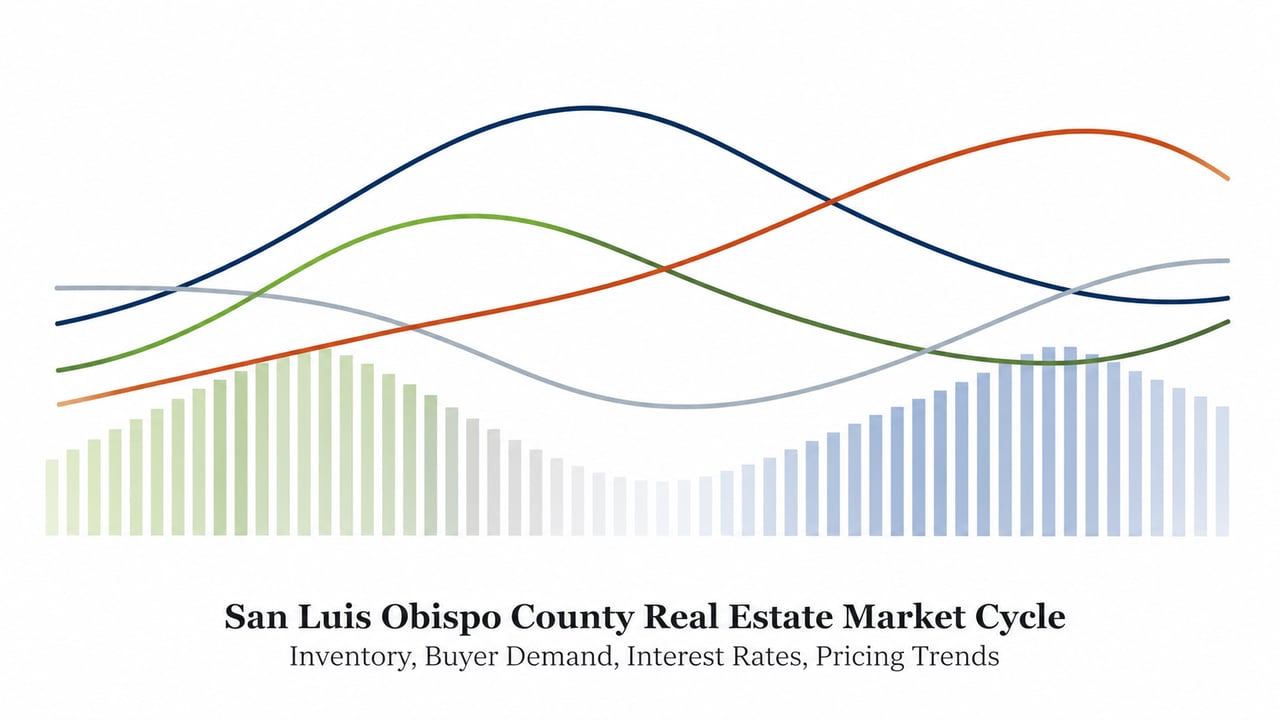
A market cycle is the pattern of change that occurs as supply, demand, affordability, interest rates, buyer confidence, seller motivation, and economic conditions shift over time. On the Central Coast, those changes can look different in San Luis Obispo, Pismo Beach, Arroyo Grande, Morro Bay, Los Osos, Nipomo, Atascadero, Templeton, Paso Robles, Avila Beach, Cayucos, and Cambria. One segment may feel competitive while another becomes more negotiable. One price range may move quickly while another slows down.
After more than 30 years in real estate, 2,130+ closed transactions, and over $1.81 billion in career sales volume, Joesef Jackson has seen multiple market cycles unfold across changing interest rate environments, buyer demand shifts, inventory shortages, lending changes, and regional lifestyle trends. The lesson is consistent: the best decisions come from understanding the cycle, not reacting emotionally to headlines.
Central Coast Neighborhood Video Tour ⬇️
Market Cycles Start With Supply and Demand
The most basic way to analyze a real estate market cycle is to look at supply and demand. When there are more buyers than available homes, sellers often gain leverage. Homes may sell faster, pricing may strengthen, and buyers may face more competition. When inventory rises and buyer demand slows, buyers often gain more negotiating power, and sellers may need to price more carefully.
In San Luis Obispo County, supply and demand are rarely uniform. A well-priced home in San Luis Obispo may still attract strong activity even when another property in a different city sits longer. A coastal home in Morro Bay or Pismo Beach may perform differently from a larger inland home in Paso Robles or Atascadero. A single-level home in Arroyo Grande may draw a different buyer pool than a condo near Cal Poly or a wine country property in Templeton.
The key is to analyze the local segment, not just the countywide headline. Price range, location, property type, condition, and buyer profile all shape the cycle.
👉 How Economic Conditions Affect the Central Coast Housing Market
One expert insight Joesef often shares with clients is that market conditions are never just “good” or “bad.” They are specific. A market can be strong for one property type and softer for another at the same time. That is why local interpretation matters.
Interest Rates Influence Buyer Behavior and Affordability
Interest rates are one of the most powerful forces in any market cycle. When rates rise, buyers may lose purchasing power, monthly payments can increase, and some buyers may pause their search. When rates fall, affordability can improve, buyer activity may increase, and competition can return quickly in desirable areas.
But interest rates do not affect every buyer the same way. A cash buyer, relocation buyer, downsizing seller, investor, first-time buyer, and move-up buyer may all respond differently. A buyer looking in San Luis Obispo may feel rate changes differently than a buyer considering Atascadero, Paso Robles, or Nipomo. A coastal second-home buyer may not be as rate-sensitive as a first-time buyer trying to stay within a tight monthly payment.
👉 How Interest Rate Changes Affect Buyers and Sellers on the Central Coast
The Federal Housing Finance Agency provides housing market data that can help consumers understand broader home price trends and market movement.
From Joesef’s 30+ years of experience, interest rates often affect psychology as much as math. Buyers do not only ask, “Can I afford this?” They also ask, “Is now the right time?” When confidence changes, market cycles can shift quickly.
Buyer and Seller Leverage Changes During the Cycle

A real estate cycle affects leverage. In a strong seller’s market, buyers may need to act quickly, write cleaner offers, and compete more aggressively. In a more balanced market, buyers may have more time, more negotiating room, and greater ability to evaluate condition or price. In a softer market, sellers may need to be more flexible, strategic, and responsive to buyer concerns.
Negotiation strategy should change with the market. A seller in a fast-moving San Luis Obispo neighborhood may not need the same strategy as a seller with a unique property in a slower price range. A buyer pursuing a high-demand coastal home in Avila Beach may need a different approach than a buyer considering a home with longer days on market in Paso Robles.
👉 How Negotiation Strategy Changes in Different Central Coast Markets
Joesef has seen that clients make stronger decisions when they understand leverage before negotiating. The right offer, counteroffer, pricing adjustment, or timing decision depends on what the current cycle is actually doing.
Market Updates Are Useful, But They Need Interpretation
Market updates can be helpful, but raw numbers alone do not tell the whole story. Median price, days on market, inventory, pending sales, and closed sales are useful indicators, but they must be interpreted carefully. A median price can rise because higher-priced homes sold, not necessarily because every home increased in value. Days on market can vary widely by property type. Inventory can rise in one segment while remaining tight in another.
A San Luis Obispo County market update may show broader movement, but the real question is how that data applies to a specific buyer, seller, investor, or property. A seller preparing a home in Arroyo Grande needs to understand comparable competition. A buyer looking in Los Osos needs to know whether homes are actually sitting or still selling quickly when priced correctly. An investor in Paso Robles needs to understand both purchase conditions and rental demand.
👉 How to Compare Multiple Properties on the Central Coast
The California Association of REALTORS® provides statewide market data and housing trends that can help place local real estate conditions into a broader California context.
A useful market update should not just report what happened. It should help explain what the numbers mean for decisions.
Rental Trends Can Reveal Investor Cycle Signals
Market cycles are not only about resale homes. Rental trends can also reveal important signals, especially for investors. If rents are rising, vacancies are low, and tenant demand is strong, investors may remain active even when purchase conditions are more challenging. If rents flatten, expenses rise, or regulations change, investors may become more selective.
On the Central Coast, rental trends can vary by community. San Luis Obispo may be influenced by Cal Poly and professional demand. Grover Beach and Arroyo Grande may attract renters seeking coastal access and relative value. Atascadero, Templeton, and Paso Robles may appeal to tenants needing more space or a different price point. Morro Bay, Los Osos, Pismo Beach, and Cayucos may be shaped by coastal lifestyle demand and limited supply.
👉 How to Forecast Rental Trends
Rental strength does not automatically mean every investment property is a good buy. Investors still need to analyze purchase price, financing, property taxes, insurance, maintenance, tenant profile, and resale. But rental demand can help show where long-term housing pressure exists.
Investment Time Horizon Changes the Meaning of the Cycle

A market cycle looks different depending on the investor’s time horizon. A short-term investor may care heavily about timing, entry price, renovation costs, resale window, and market momentum. A long-term investor may care more about rental durability, location strength, financing, property condition, tenant demand, and future flexibility.
A buyer planning to hold a property for 15 years in San Luis Obispo County may analyze the cycle differently than someone hoping to resell in 18 months. Short-term strategies require more precision because market shifts can quickly affect profit. Long-term strategies can sometimes absorb more short-term volatility if the property fundamentals are strong.
👉 How to Analyze Long-Term vs Short-Term Investment Strategies
One of Joesef’s expert insights is that timing matters, but fundamentals matter more over time. A strong property in a durable location can often weather cycles better than a weaker property purchased only because the timing felt attractive.
Inventory Quality Matters as Much as Inventory Quantity
When analyzing a market cycle, many people focus on how many homes are available. That matters, but quality of inventory matters too. If inventory rises but most available homes are overpriced, dated, poorly located, or difficult to finance, buyers may still compete for the best properties. If inventory is low but the available homes match buyer demand poorly, activity may still feel uneven.
This is especially true in San Luis Obispo County, where homes are highly varied. A clean, well-located home in San Luis Obispo may not compete directly with a rural property near Paso Robles. A coastal property in Morro Bay may not compare easily with a newer home in Nipomo. A condo, single-family home, acreage property, and luxury estate may each follow different patterns.
Buyers should not assume that more listings automatically mean better choices. Sellers should not assume that low inventory guarantees strong demand for every property. The quality, condition, price, and relevance of available inventory all matter.
Pricing Strategy Must Match the Cycle
Pricing is one of the clearest places where market cycle analysis matters. In a rising or highly competitive market, sellers may have more room to price confidently. In a balanced market, pricing must be more precise. In a slowing market, overpricing can cause a property to sit, lose momentum, and require later adjustments.
A seller’s pricing strategy should reflect current competition, buyer behavior, property condition, days-on-market patterns, and recent comparable sales. It should also account for where the cycle appears to be heading. If buyer demand is cooling, pricing based only on older sales may be risky. If demand is strengthening, a well-positioned property may generate more activity than expected.
For buyers, pricing strategy matters because an asking price is not always the same as value. Some homes are priced to attract competition. Others are priced optimistically. Some are priced accurately but require context to understand. A buyer should look beyond the list price and analyze how the property fits the current market cycle.
Buyer Psychology Is a Market Signal
Buyer behavior can reveal where a cycle is moving. When buyers tour quickly, write offers promptly, and compete for well-positioned homes, demand is active. When buyers watch listings, wait for price reductions, ask more questions, and negotiate more aggressively, the market may be shifting toward balance or softness.
This does not mean buyers disappear when a market changes. Many buyers remain active, but they become more selective. They may still move quickly for the right property, but they are less forgiving of overpricing, poor condition, unclear disclosures, or weak presentation.
On the Central Coast, buyer psychology is strongly tied to lifestyle and confidence. A buyer may stretch for a rare coastal home in Pismo Beach. Another may wait for better value in Atascadero. A San Luis Obispo buyer may act quickly when a well-located home appears because they know replacement options are limited. These behavioral patterns are part of the cycle.
Sellers Should Watch Competition, Not Just Past Sales
Past sales are important, but active competition is often what buyers are comparing right now. A seller may feel confident because a similar home sold well three months ago, but if several competing homes are now available, buyer behavior may change.
A seller should ask: What else can buyers buy today? How does this home compare on price, condition, location, layout, and presentation? Are competing homes reducing prices? Are they going pending quickly? Are buyers showing urgency or hesitation?
Market cycle analysis is current, not just historical. A home’s value is influenced by recent sales, but its marketability is shaped by current alternatives.
Buyers Should Avoid Trying to Perfectly Time the Market
Many buyers want to buy at the exact bottom of a cycle. In reality, market bottoms are usually only clear after they have passed. Waiting for perfect timing can cause buyers to miss homes that fit their life and long-term goals.
That does not mean buyers should ignore the cycle. They should understand it. But the best purchase decision usually combines market awareness with personal readiness. If the property, location, payment, condition, and long-term plan make sense, waiting for a perfect headline may not be the best strategy.
A buyer purchasing a home for long-term use in San Luis Obispo County should think carefully about lifestyle, affordability, ownership horizon, and property fundamentals. Market timing matters, but it should not overpower the full decision.
The Best Cycle Analysis Is Local, Practical, and Specific
The strongest market cycle analysis is not dramatic. It is practical. It asks what is happening in this location, at this price point, for this property type, with this buyer pool, under these financing conditions.
After more than three decades helping clients buy and sell on the Central Coast, Joesef Jackson understands that markets are always changing. But good decisions are built the same way: clear data, local experience, realistic expectations, and calm interpretation.
A market cycle should guide strategy, not create fear. Buyers, sellers, and investors who understand the cycle can make better timing decisions, stronger offers, smarter pricing choices, and more realistic long-term plans.
FAQ
What is a real estate market cycle?
A real estate market cycle is the pattern of change in supply, demand, pricing, buyer activity, seller leverage, interest rates, inventory, and confidence over time.
How do you analyze market cycles in San Luis Obispo County?
Market cycles should be analyzed by reviewing inventory, buyer demand, days on market, pricing trends, interest rates, negotiation patterns, property condition, and community-specific activity.
Do all Central Coast communities follow the same cycle?
No. San Luis Obispo, Pismo Beach, Arroyo Grande, Morro Bay, Atascadero, Paso Robles, Nipomo, and other communities can move differently depending on buyer demand, inventory, price range, and property type.
How do interest rates affect market cycles?
Higher rates can reduce affordability and slow buyer activity, while lower rates can increase purchasing power and competition. The effect varies depending on buyer profile and property segment.
Should sellers price differently in different market cycles?
Yes. Pricing strategy should reflect current demand, competition, condition, recent sales, and buyer behavior. Overpricing is riskier when the market is balanced or slowing.
Can investors use market cycles to make better decisions?
Yes. Investors can use market cycles to evaluate timing, rental demand, purchase price, financing, expenses, appreciation potential, and long-term hold strategy.
Should buyers wait for the market to drop?
Not always. Buyers should understand the market, but decisions should also be based on affordability, property fit, ownership timeline, and long-term goals. Perfect timing is difficult to predict.
Why does local experience matter when analyzing market cycles?
Local experience helps interpret how broad market trends apply to specific neighborhoods, price ranges, property types, and buyer behavior in San Luis Obispo County and on the Central Coast.
If you are preparing to buy or sell real estate on the Central Coast and want personalized guidance, contact Joesef Jackson at SLO Life Realty Group.
This article intentionally connects to both published and future Central Coast real estate resources as part of a long-term geographic authority strategy. Some plain-text references may become active links as additional San Luis Obispo County and Central Coast content is published.