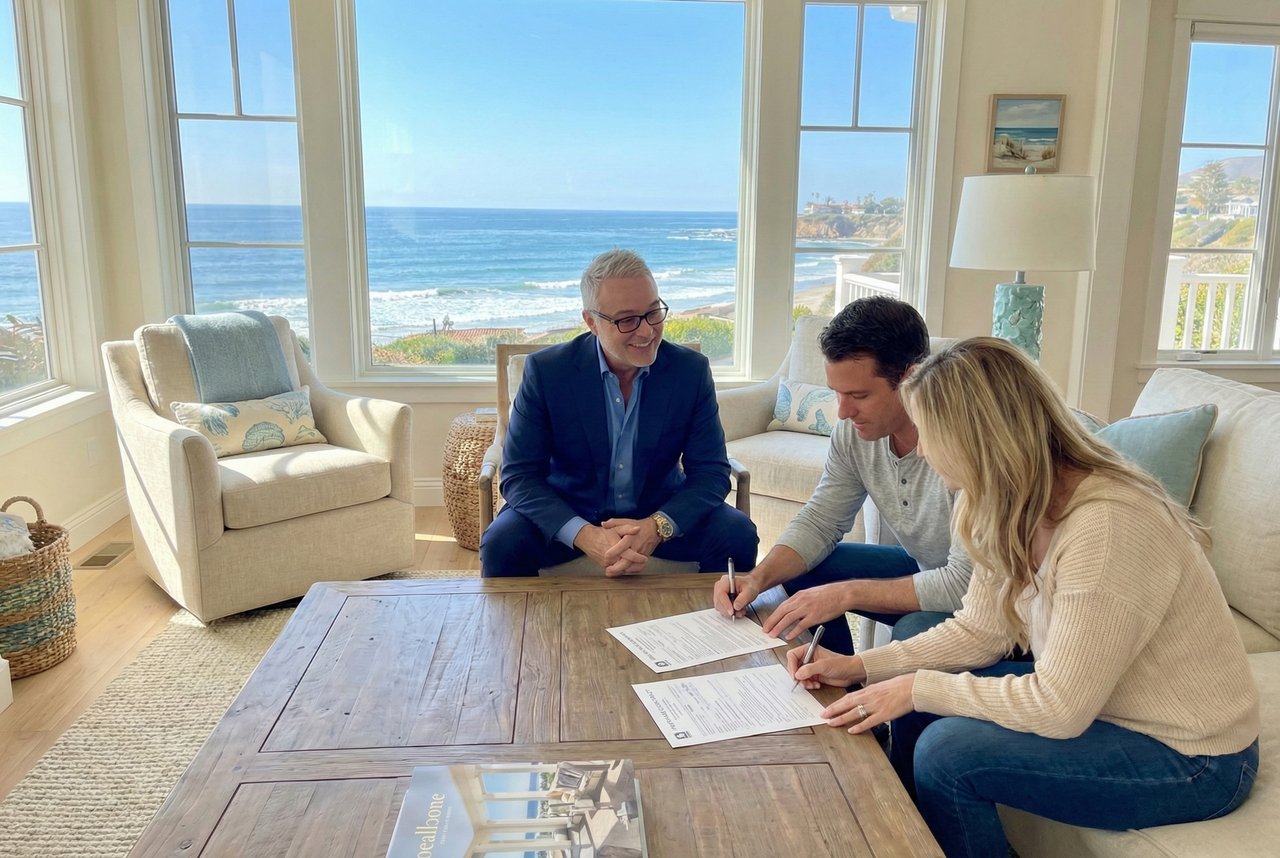
Protecting listing value during negotiations does not mean refusing to compromise. It means understanding which concessions materially change the economics of the sale, which terms increase transaction risk, and where flexibility can preserve a strong agreement without unnecessarily weakening the seller's position.
A seller may receive an attractive offer and still negotiate several important points before closing. Contingencies, credits, appraisal issues, repair requests, closing dates, possession, financing structure, and later transaction developments can all change the value of the original agreement.
On the Central Coast, those decisions also depend on the property's competitive position. A distinctive residence in Cayucos with limited comparable inventory may carry different leverage from a home competing against several similar listings in a larger subdivision. A seller with multiple interested buyers operates differently from one negotiating with the only active prospect.
The strongest strategy is to evaluate each request in context. Sellers protect value when they understand what has already been negotiated, what remains at risk, and whether giving something up improves the probability or quality of the final transaction.
Central Coast Neighborhood Video Tour ⬇️
Contingencies Affect More Than the Calendar
A buyer's offer includes protections that can influence both transaction certainty and seller leverage.
👉 What Sellers Should Know About Buyer Contingencies in San Luis Obispo County
Investigation, appraisal, financing, and other contingencies can give the buyer contractual opportunities to evaluate specific aspects of the purchase before proceeding without those protections.
The seller should therefore consider more than whether an offer reaches the desired price. Two buyers offering the same amount can present very different levels of uncertainty depending on financing, contingency periods, property-sale requirements, and other terms.
A shorter contingency period can be valuable when it is realistic. An aggressive deadline that the buyer cannot reasonably meet may create more difficulty than a slightly longer period supported by solid preparation.
After more than 30 years representing Central Coast real estate, Joesef Jackson has found that sellers often preserve value more effectively when they evaluate how dependable the offer is rather than treating every contractual protection as secondary to price.
Certainty has value, particularly when accepting one buyer means removing the property from active competition.
Buyer Competition Can Give Sellers More Choices, Not Just a Higher Price
Competition strengthens a seller's position because the negotiation no longer depends on reaching agreement with one purchaser.
👉 How to Create Buyer Competition When Selling on the Central Coast
When several serious buyers are evaluating the property at the same time, the seller may be able to compare price, financing, contingencies, timing, credits, and overall transaction strength instead of negotiating each term in isolation.
That does not mean every buyer should be pushed toward increasingly aggressive terms.
The value of competition is optionality.
A seller who knows another buyer remains genuinely engaged can evaluate a concession request differently from a seller who has no alternative demand. The same principle applies during the first days of marketing, before formal offers arrive.
Showing activity, repeat visits, agent inquiries, disclosure requests, and conversations about offer timing can indicate whether legitimate competition is developing.
Protecting listing value begins before negotiations when the property is positioned well enough to attract more than one credible buyer.
Pricing Errors Can Weaken Negotiating Power Before an Offer Arrives
Negotiating strength is partly established by the list price.
👉 How to Avoid Common Pricing Mistakes in San Luis Obispo County
A home positioned substantially above the level buyers consider supportable may remain available longer, accumulate market history, and eventually attract buyers who expect substantial negotiation.
That can place the seller in a weaker position before the first offer is written.
The opposite can also occur when pricing is strategically aligned with buyer expectations and available competition. Strong initial response can give the seller greater ability to defend value because the buyer understands that the property is attracting attention.
With more than 2,130 career transactions, Joesef has seen sellers focus on the amount they hope to negotiate toward while overlooking the leverage created—or lost—by the original pricing decision.
List price should establish a credible starting position. It should not require the seller to overcome buyer skepticism throughout the negotiation.
Unique Homes Need a Value Argument Buyers Can Understand
Distinctive properties can be especially challenging during negotiations because the buyer may have fewer direct comparable sales to evaluate.
👉 How to Price a Unique or Hard-to-Compare Home on the Central Coast
A custom residence, substantial acreage property, architecturally unusual home, ocean-oriented property, or residence with uncommon amenities may not fit neatly into a standard price-per-square-foot comparison.
That can create room for disagreement.
The seller protects value by identifying why the property is different and which differences buyers in that segment actually value. Architecture, site, privacy, usable land, views, location, craftsmanship, or scarcity may all contribute.
A Paso Robles estate with significant usable acreage should not necessarily be negotiated as though its land were interchangeable with a conventional residential lot. A Morro Bay property with a rare combination of view, parking, and outdoor space may warrant a different comparison from nearby homes lacking those characteristics.
The stronger the value argument, the easier it becomes to distinguish defensible pricing from seller aspiration.
Today's Buyers May Negotiate Differently Than Buyers Did Several Months Ago

Seller strategy should reflect current buyer behavior rather than an outdated market environment.
👉 How to Price for Today’s Buyer Mindset on the Central Coast
Buyers may become more price-sensitive when financing costs increase, inventory expands, or competing homes remain available longer. They may become more aggressive when desirable options are scarce and several purchasers are pursuing similar properties.
Mortgage costs can influence that behavior because a change in the interest rate changes the monthly payment associated with the same purchase price. Freddie Mac publishes its Primary Mortgage Market Survey as a national benchmark for mortgage-rate conditions.
Sellers do not need to react to every financial headline. They do need to recognize when buyer behavior has changed enough to affect the negotiation.
A buyer who could comfortably absorb a modest price difference in one financing environment may become more focused on credits or price in another.
Understanding the buyer's current decision framework can preserve more value than negotiating as though every market operates the same way.
A Home Can Defend Its Value Without Being the Highest-Priced Option
Strong negotiating positions do not always come from asking the most.
👉 What Makes a Home Stand Out Without Overpricing in San Luis Obispo County
A property can feel compelling because its overall combination of price and features compares favorably with the alternatives.
That matters during negotiation because buyers are more likely to defend their interest when they believe replacing the property will be difficult.
A well-positioned Arroyo Grande home may stand apart because of lot usability, natural light, garage capacity, and a particularly strong indoor-outdoor connection. Another property may compete through location, architectural character, or a hard-to-find configuration.
The seller protects value by understanding which characteristics create scarcity.
If the home is clearly differentiated, the negotiation does not need to rely entirely on insisting that the asking price is correct. The buyer can see why losing the property carries a cost.
Net Proceeds Matter More Than the Headline Offer
A seller should evaluate what remains after negotiated credits and obligations are considered.
A buyer may offer a strong purchase price while requesting a substantial closing-cost credit. Another may ask the seller to pay for specific work before closing. Later inspection negotiations can introduce additional financial adjustments.
Each request needs to be added to the transaction already negotiated.
A $15,000 concession does not become economically insignificant simply because it is labeled a credit instead of a price reduction.
Sellers should therefore maintain a current understanding of the effective transaction rather than repeatedly referring to the original offer price.
The purchase price is visible. The accumulated concessions can be quieter.
Appraisal Exposure Should Be Considered Before Celebrating an Aggressive Offer
A financed buyer's high offer may introduce another question: whether the appraisal will support the financing structure.
The Federal Housing Finance Agency provides information about property valuation and appraisal modernization within the mortgage market, reflecting the continuing importance of reliable collateral valuation in financed transactions.
An appraisal does not determine what a property is universally worth. It serves a specific purpose within the lender's risk analysis.
For sellers, the concern is practical. If an offer significantly exceeds readily available comparable evidence, what happens if the valuation comes in lower than expected?
The purchase agreement, buyer's financial capacity, contingency structure, and willingness of the parties to respond all matter.
A very high offer can be valuable. Its strength depends partly on how much of that price is likely to survive the appraisal and financing process.
Inspection Negotiations Should Stay Connected to the Original Deal
Once inspections begin, sellers can feel as though an entirely new negotiation has started.
Economically, it is still the same transaction.
A buyer may request repairs, a credit, a price adjustment, or additional evaluation. Some requests may result from information neither party reasonably understood when the offer was accepted.
Those concerns deserve evaluation.
Other requests may involve minor items that do not materially change the value or usability of the property.
The seller protects listing value by distinguishing between new information that genuinely affects the transaction and requests that primarily seek to improve the buyer's economics after agreement.
Every concession should be considered against what the buyer already received in the original negotiation.
The Seller's Alternatives Affect the Cost of Saying No

Negotiating leverage is partly the ability to reject a request without creating an unacceptable result.
A seller with continued buyer interest, strong backup prospects, or a property likely to return successfully to the market may have more room to hold firm.
A seller whose property has been available for a long time with limited activity may reasonably evaluate the same request differently.
This does not mean market time automatically determines the answer.
It means the consequences of disagreement should be understood before the seller chooses a position.
The strongest negotiation occurs when the seller knows both the value of accepting the buyer's request and the realistic cost of declining it.
Closing-Cost Requests Need an Economic Reason
Buyer credits can be useful negotiating tools, particularly when financing makes available cash an important issue.
The seller should still understand why the credit is being requested and what the buyer is offering in exchange.
A credit may allow a strong buyer to preserve cash for closing while maintaining a purchase price that remains acceptable to the seller. In another transaction, the same request may simply reduce the seller's proceeds without improving any meaningful term.
The question is not whether credits are good or bad.
It is whether the complete structure improves the probability and quality of the transaction enough to justify the seller's contribution.
Counteroffers Are Strongest When They Focus on the Important Differences
A seller does not need to rewrite an entire offer simply because several terms could theoretically be improved.
Counteroffers become easier to evaluate when they focus on what actually matters.
Price may deserve adjustment. A contingency period may need modification. Closing timing might be important. A requested credit could need to change.
Other acceptable terms can remain untouched.
This keeps the negotiation focused and reduces the chance that minor issues create unnecessary friction.
A useful counteroffer should move the parties closer to a workable agreement while protecting the seller's most important objectives.
Timing Flexibility Can Have Real Value
Not all value is monetary.
A seller purchasing another home may place considerable importance on a particular closing schedule. Another may need time after closing to coordinate a move. A buyer who accommodates that timing can provide value without increasing the purchase price.
Conversely, a buyer requesting timing that creates significant inconvenience or financial cost for the seller may be asking for a meaningful concession.
These considerations should be identified before offers arrive whenever possible.
A seller who knows which timing terms matter can compare proposals more accurately and avoid sacrificing price simply because practical needs were not considered early enough.
Personal Property Should Not Distort a Large Real Estate Negotiation
Furniture, appliances, wine refrigerators, outdoor equipment, televisions, and other personal property can become surprisingly contentious.
The seller should keep those items in proportion to the transaction.
If an item is valuable or personally important, it should be addressed deliberately. If it is relatively insignificant, allowing it to derail a strong real estate agreement may make little economic sense.
The same applies when buyers attach unusual importance to an item.
Successful negotiation requires recognizing when a secondary issue is beginning to consume attention disproportionate to its actual value.
Repeated Concessions Can Change the Character of the Agreement
One concession may be reasonable.
Several unrelated concessions can eventually turn a strong sale into a substantially different transaction.
The seller may agree to a buyer credit initially, make another adjustment after inspections, accept an appraisal-related change, and then face a final request involving timing or possession.
Each decision may seem manageable on its own.
Collectively, they can alter the economics and risk of the agreement.
Direct representation from the first seller conversation through closing allows Joesef Jackson to keep the complete negotiating history connected so the seller can see what has already changed before considering another request.
Emotional Reactions Can Cost More Than the Issue Being Negotiated
Negotiations can become personal when sellers feel that a buyer is criticizing the home or attempting to take advantage of the situation.
A low counteroffer, repair request, or credit demand can create that reaction.
The better question is economic: what happens if the seller accepts, counters, or refuses?
A buyer's tone does not change the value of the request. The numbers, contract position, alternatives, and probability of closing do.
Joesef's experience representing more than $1.81 billion in career sales volume has reinforced that keeping the seller focused on the consequence of each decision generally produces better negotiations than reacting to whether a request feels fair.
Protecting Value Sometimes Requires Strategic Flexibility
Holding firm is not always the same as protecting value.
A seller may preserve an excellent transaction by conceding a relatively small issue that carries outsized importance to the buyer. Rejecting that request simply to avoid giving anything up could put substantially more value at risk.
The reverse is equally true.
A seemingly small concession can become expensive when added to previous adjustments or when it signals that every new request will be granted.
Strategic flexibility means knowing the difference.
The Best Negotiation Protects Both Economics and Probability of Closing
A seller can negotiate an exceptional headline price and still end up with a fragile transaction.
Another seller may accept slightly different economics while securing a buyer with strong financing, workable contingencies, practical timing, and a high probability of completing the purchase.
Listing value should therefore be viewed through two lenses: what the agreement is worth and how likely it is to reach closing on those terms.
For Central Coast sellers, protecting value requires managing both.
Price matters. So do credits, contingencies, financing, appraisal exposure, inspection requests, timing, possession, and the seller's alternatives if agreement cannot be reached.
The strongest negotiation is not the one where the seller refuses the most requests. It is the one where flexibility is used deliberately and the important value of the property remains protected through the final agreement.
Frequently Asked Questions
What does protecting listing value during negotiations mean?
It means preserving the economic strength and transaction quality of the sale while deciding where flexibility on price, credits, contingencies, timing, and other terms makes sense.
Should sellers always choose the highest offer?
No. Financing, contingencies, requested credits, appraisal exposure, timing, and the buyer's ability to perform can make a slightly lower offer more attractive.
How do buyer contingencies affect seller leverage?
Contingencies can create additional uncertainty and decision points before closing. Their length and structure can therefore affect the overall strength of an offer.
Can a seller credit reduce the real value of an offer?
Yes. A seller-paid credit reduces the seller's economic proceeds and should be included when comparing the effective value of proposals.
Should sellers agree to repairs after accepting an offer?
That depends on the inspection findings, purchase agreement, significance of the issue, buyer request, market conditions, and consequences of failing to reach agreement.
Why does appraisal risk matter during negotiation?
A financed buyer may depend on the lender's valuation. An aggressive purchase price can become more complicated if the appraisal does not support the expected financing.
When should a seller hold firm?
Holding firm may be appropriate when the property's competitive position, other buyer interest, existing concessions, and seller priorities support the current terms.
Can flexibility actually protect the seller's value?
Yes. A limited concession can preserve a strong transaction when it resolves an issue important to the buyer without materially weakening the seller's overall position.
If you are preparing to buy or sell real estate on the Central Coast and want personalized guidance, contact Joesef Jackson at SLO Life Realty Group.